
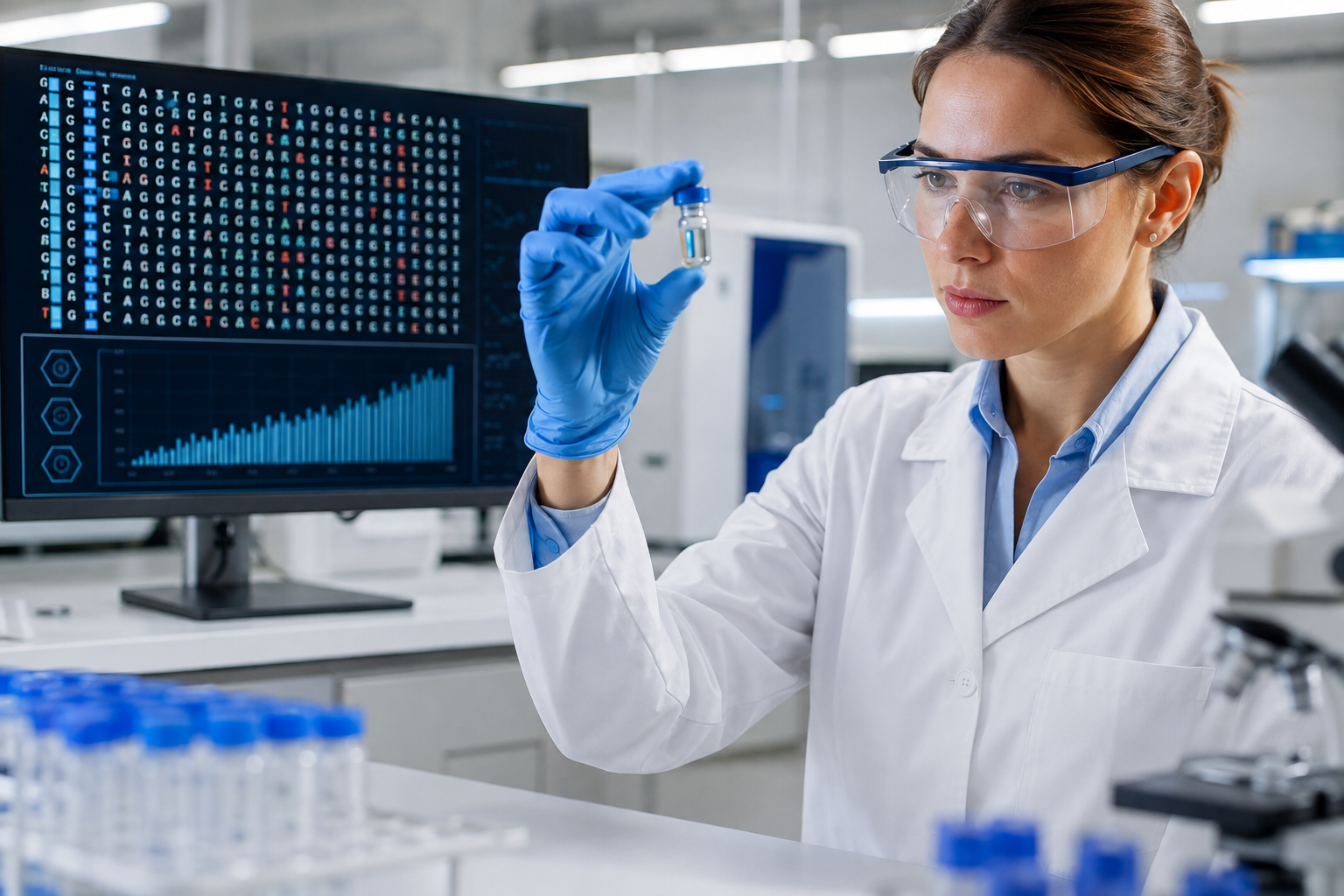

Researchers estimate that the memory of the human brain could be 2.5 petabytes. At the same time, scientists were able to code whole books into DNA fragments. What does this storage capacity mean for the future of technology and artificial intelligence?
(Staff: Global / Science & Technology)
How much information can the human brain store?
The human brain is often described as the most powerful “computer” that ever existed. With about 86 billion neurons and over 100 trillion synaptic connections, its theoretical storage capacity is estimated to be approximately 2.5 petabytes (2.5 million gigabytes)[0†L6-L7][1†L7-L10][1†L24-L25]. . To put this figure into perspective: 2.5 petabytes would be enough to store around 3 million hours of TV shows, which means 300 years of uninterrupted viewing [0†L17-L19][1†L13]. .
This massive capacity does not come from a physical storage space, but from the way information is distributed and processed in neural networks. Each neuron can form thousands of connections, and each connection can store information[0†L6-L7]. . The brain is not a static hard drive, but a dynamic system that constantly reconfigures itself, storing memories, abilities and thoughts through complex patterns of electrical and chemical signals.
What does 2.5 petabytes mean for current technology?
To store 2.5 petabytes of data, you would need approximately 1,000 2.5 TB hard drives Or a whole fleet of servers. Instead, the human brain does this by consuming only about 20 watts of energy – enough to power a light bulb. It is an energy efficiency millions of times higher than that of the most advanced computers.
Data storage in DNA – the future of archiving
If this impressive capacity is not enough, scientists explore further: Data storage in DNA. Theoretically, a single gram of DNA could store between 215 and 455 exabytes of data[2†L9-L11][2†L19][3†L6-L7]. . An exabyte is the equivalent of a billion gigabytes. Basically, the entire amount of digital data generated by mankind to date could be stored in a volume of DNA the size of a cup of tea[3†L10-L12]. .
How does DNA storage work?
The idea is simple in theory: digital information (sequences of 0 and 1) is converted into nucleotide sequences (A, T, G, C) and synthesized as DNA. Subsequently, this DNA can be sequenced to recover the information. Already, researchers have managed to encode whole books, images, and even audio files in DNA fragments[3†L9-L10][3†L14-L15]. .
Advantages of DNA storage
- Huge density: A gram of DNA can store more data than all Google servers combined[2†L23-L24]. .
- Extreme Durability: Under appropriate conditions, DNA can remain stable for hundreds of thousands of years, unlike hard drives that degrade in decades.
- Energy efficiency: DNA does not require energy to be stored, unlike data centers that consume huge amounts of electricity.
Challenges and perspectives
Though promising, DNA storage technology still faces challenges: synthesis and sequencing costs are still high, and the write and read speed is much lower than that of conventional memory. However, rapid advances in the field of biotechnology suggest that these obstacles may be overcome in the next 10-20 years.
Conclusion
The human body is a treasure of technological potential. Our brain, with its 2.5 petabytes, is a product of evolution, and our DNA is a storage medium with a density that exceeds any imagination. Understanding these mechanisms not only reveals the secrets of our own biology, but also opens the way to a new era of technology – one where data will be stored in molecules, and artificial intelligence could learn from the greatest “computer” in the universe: the brain human.





Leave a Reply