
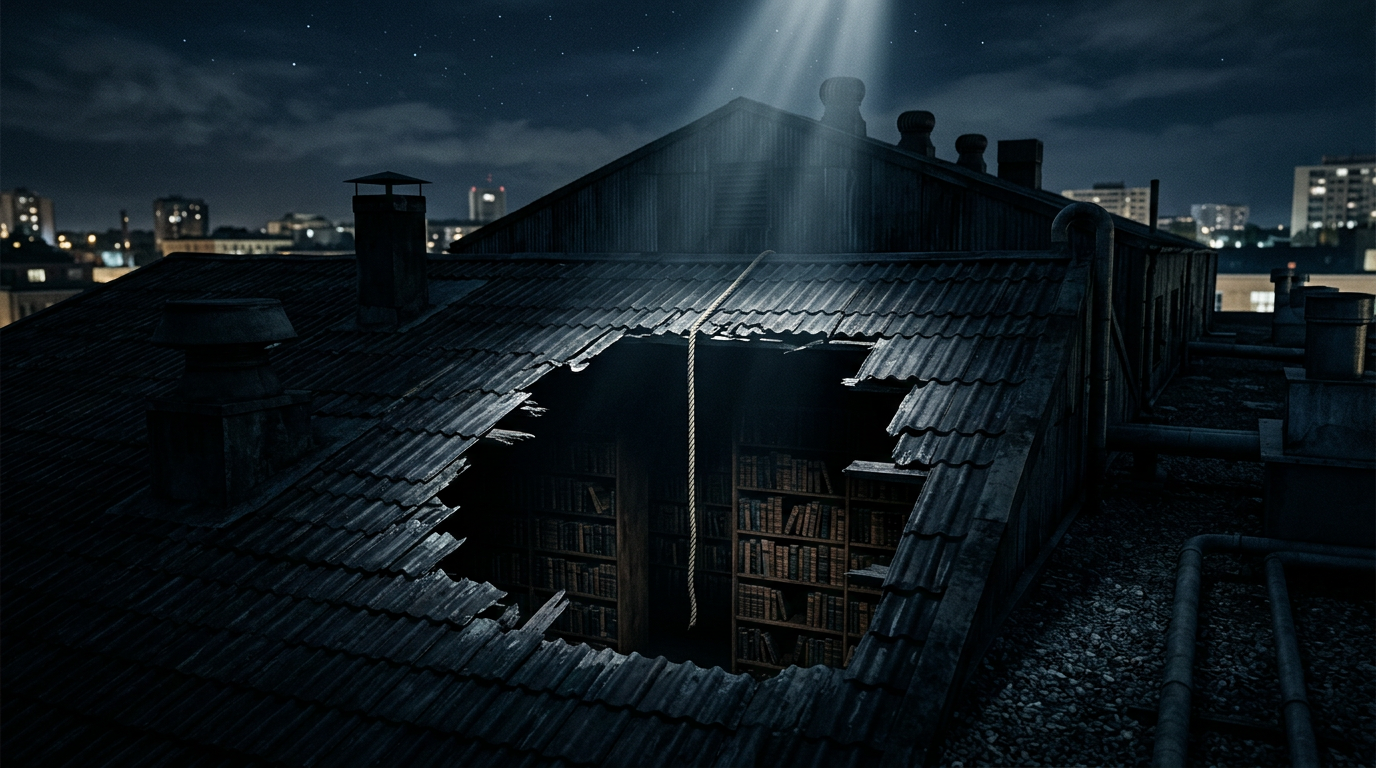

In January 2017, thieves broke into a warehouse in west London through the roof. They abseiled 12 metres down, avoided the motion sensors and stole 240 rare books — including first editions and works by Galileo, Newton and Goya — worth more than £2.5 million. The books were recovered in 2020, buried at a house in Neamț County, Romania. Twelve men were later sentenced to more than 48 years in prison.
(Staff: United Kingdom & Romania / Justice & Crime)
One of the most spectacular book heists in recent history took place on the night of 29–30 January 2017 at a postal transit warehouse in Feltham, west London. Operated by Frontier Forwarding, the warehouse held a collection of rare books destined for the United States for a specialist auction. The gang worked with almost military precision, using techniques that quickly drew comparisons with “Mission: Impossible”.
The method: acrobatics, patience and avoiding the alarms
Two thieves cut a hole in the warehouse roof and abseiled 12 metres into the building. To avoid the motion and alarm sensors, they moved from shelf to shelf without touching the floor. The operation lasted about five hours. The books were carefully lowered into 16 large bags, and the thieves left the building the same way they had entered. No alarm was triggered and security staff noticed nothing.
The haul: 240 rare books of enormous cultural value
The approximately 240 volumes were not ordinary old books. They included rare editions dating from the 15th to the 18th centuries, among them a 1566 copy of De revolutionibus orbium coelestium by Nicolaus Copernicus, valued at about £215,000; editions of Aesop’s Fables and tragedies by Euripides printed in Venice by Aldus Manutius; works by Galileo Galilei and Sir Isaac Newton, including a rare edition of Principia; and 80 drawings by Spanish painter Francisco de Goya.
British police described the works as being of “international cultural importance” and “irreplaceable”. They belonged to three dealers — two Italian and one German — and had been sent to London for export to the United States.
The gang and its links to organised crime
The investigation lasted more than three years and involved cooperation between authorities in the United Kingdom, Romania and Italy, with support from Europol and Eurojust. Investigators identified an organised crime group made up of Romanian nationals and linked to the Clamparu crime network.
The group operated across borders. Members were brought to the UK specifically to carry out individual burglaries and then left the country quickly, while other members transported the stolen goods out of Britain. Investigators linked the gang to 12 warehouse burglaries in the UK between December 2016 and April 2019, targeting high-value, easily transportable goods such as smartphones, tablets and laptops. Prosecutors estimated the total value of the stolen goods at about £4.5 million.
The hiding place: under a concrete slab in a house in Neamț
The books were taken to Romania and carefully hidden. In September 2020, following searches in Neamț, Iași and Suceava counties, Romanian authorities discovered them at a house in Neamț County. The volumes had been wrapped in plastic, placed in two bins and hidden beneath the floor of an outbuilding, under a concrete slab. Some had also been buried beneath the floor of the house.
Chief Commissioner Tudor Emil, head of the Criminal Investigation Directorate, said at the time that the books had been hidden in a concealed space beneath a garage and covered with a concrete slab. Fortunately, despite their great value, the books were found in relatively good condition.
The sentences: 48 years and five months in prison
In October 2020, 12 Romanian men were sentenced at Kingston Crown Court for a series of burglaries, including the Feltham heist. Their combined sentences totalled 48 years and five months.
Judge Jonathan Davies told the defendants they had been part of a criminal network responsible for serious, professional offences and that each had played a role while knowingly taking risks for financial gain. He described the burglaries as carefully planned operations carried out with skill worthy of “Mission: Impossible”.
The longest sentence, five years and eight months, was given to Gavril Popinciuc, 45, who was considered to have had a supervisory and controlling role in the group. Christian Ungureanu, 41, who the court found had a leadership role and had been present at burglary sites, also received a substantial sentence.
The return of the books: a happy ending after three and a half years
In November 2020, 236 of the 240 books were returned to their rightful owners. Alessandro Riquier, one of the affected Italian dealers, said that after three and a half years the terrible story finally had a happy ending. He had travelled to Bucharest worried about the condition of the books, but was delighted to hold them again. Apart from one missing book and four damaged volumes, the books were in good condition.
Conclusion
The Feltham heist remains one of the most spectacular and well-documented cases of cultural-property theft in recent history. It highlights both the sophistication of transnational organised crime and the importance of international cooperation in recovering irreplaceable cultural treasures. For the 12 convicted men, their “Mission: Impossible” ended with prison sentences to match the audacity of the crime.


Leave a Reply