
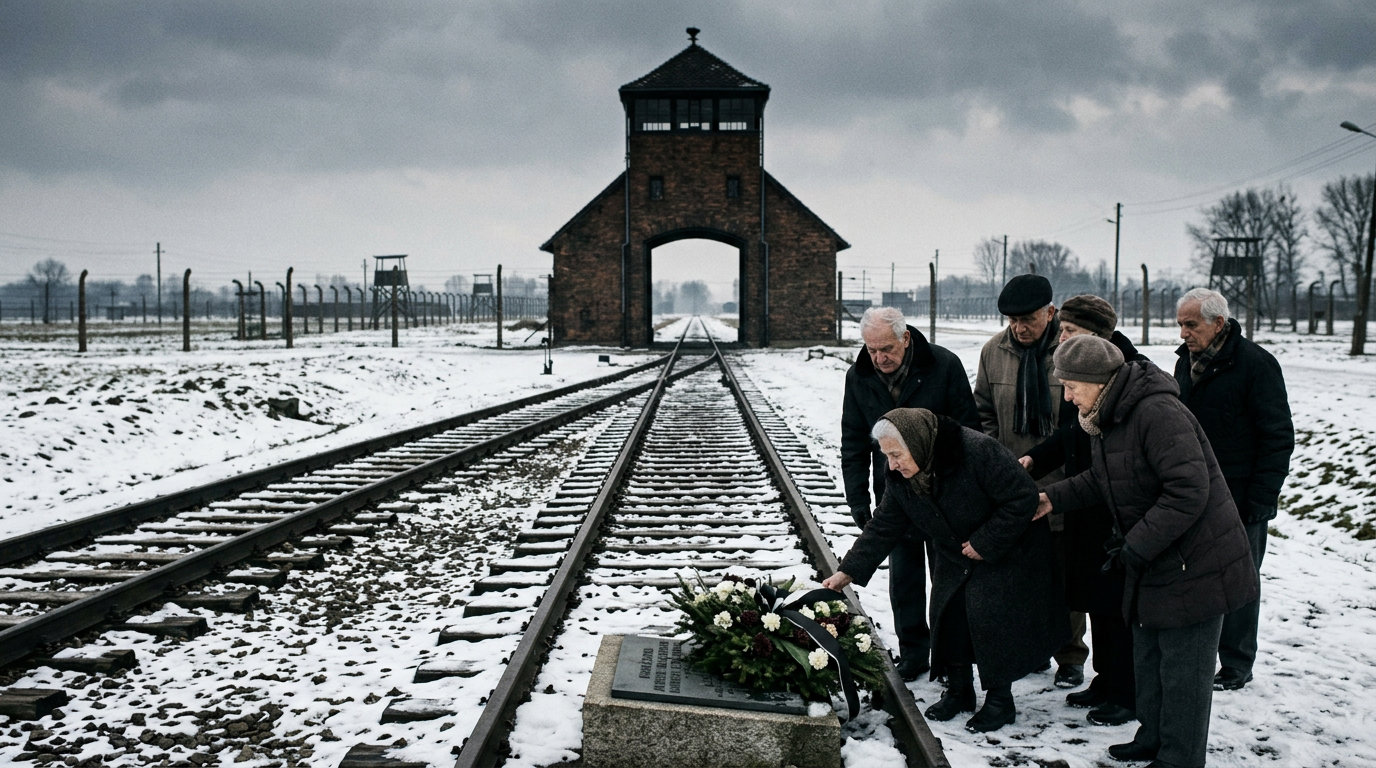

As the world commemorates 80 years since the liberation of the Auschwitz-Birkenau extermination camp, a controversial question has sparked a wave of reactions on a social network: why was no Russian delegation invited? The answers reveal a deep historical confusion between “Russia” and the “USSR” and a struggle for control of the historical narrative in the context of the war in Ukraine.
(Staff: Poland & Europe / History & Geopolitics)
On the 80th anniversary of the liberation of the Auschwitz-Birkenau concentration and extermination camp by the Red Army, official commemorations sparked a heated debate about the absence of a Russian delegation. While Polish officials stressed that invitations were sent only to states that respect “democratic standards and fundamental values,” critics accused them of politically reinterpreting history. A post on a social network attempted to bring the necessary nuance to this discussion.
“Auschwitz was liberated by Soviets, not Russians”
User Cees J. M. Lanting drew attention to a common historical confusion: “Weer een onbenul die zijn geschiedenis niet kent en over Russen en Rusland praat als het om SOVIETS en de USSR gaat,” he wrote. “Auschwitz werd bevrijd door SOVIETS, en dus Oekraïners, Georgiërs, Wit-Russen… en ook Russen, maar niet alleen door Russen.” He stressed that speaking of “Russians” and “Russia” instead of “Soviets” and the “USSR” plays into the current propaganda of the Kremlin.
Ukraine’s disproportionate losses in World War II
Lanting also brought up the disproportionate human losses suffered by Ukraine within the Red Army. “Russian commanders first sacrificed Ukrainians for dangerous operations; Ukraine lost proportionally more soldiers than other USSR states,” he wrote, mentioning that out of 4 million Ukrainian soldiers enlisted in the Red Army, approximately 2.5 million were killed or wounded. This historical reality is often ignored in current public discourse, which tends to present the liberation as an exclusively Russian act.
Collaboration and the complex realities of war
Another aspect mentioned was collaborationism. Lanting stressed that in Russia itself there was significant collaboration with the German occupiers, including the formation of the Russian Liberation Army (ROA). Not only Ukrainians collaborated with the Nazis, but also citizens of other nationalities, including Russians, Belgians, Dutch and French. Historians stress that in territories occupied by the USSR before the war, Germans were sometimes welcomed as liberators from Stalin’s regime.
The current political context
Russia’s absence from the Auschwitz commemorations is a symbolic decision in the context of the Russian invasion of Ukraine. Polish officials have made clear that this decision reflects Poland’s and the international community’s position on Russia’s current actions. It is a painful reality: history is being used as a weapon in today’s conflict.
Conclusion
The debate about the invitation to Auschwitz shows how easily history can be manipulated for political purposes. The distinction between “Soviets” and “Russians” is not just a matter of terminology, but a key to understanding the complexity of World War II and how victims and heroes are commemorated. While younger generations forget and propaganda attempts to rewrite the past, it is essential to remember that the liberation of the camps was the result of the joint effort of hundreds of nationalities that fought against Nazism. Respect for the memory of the victims should not be held hostage to current political disputes.

Leave a Reply