
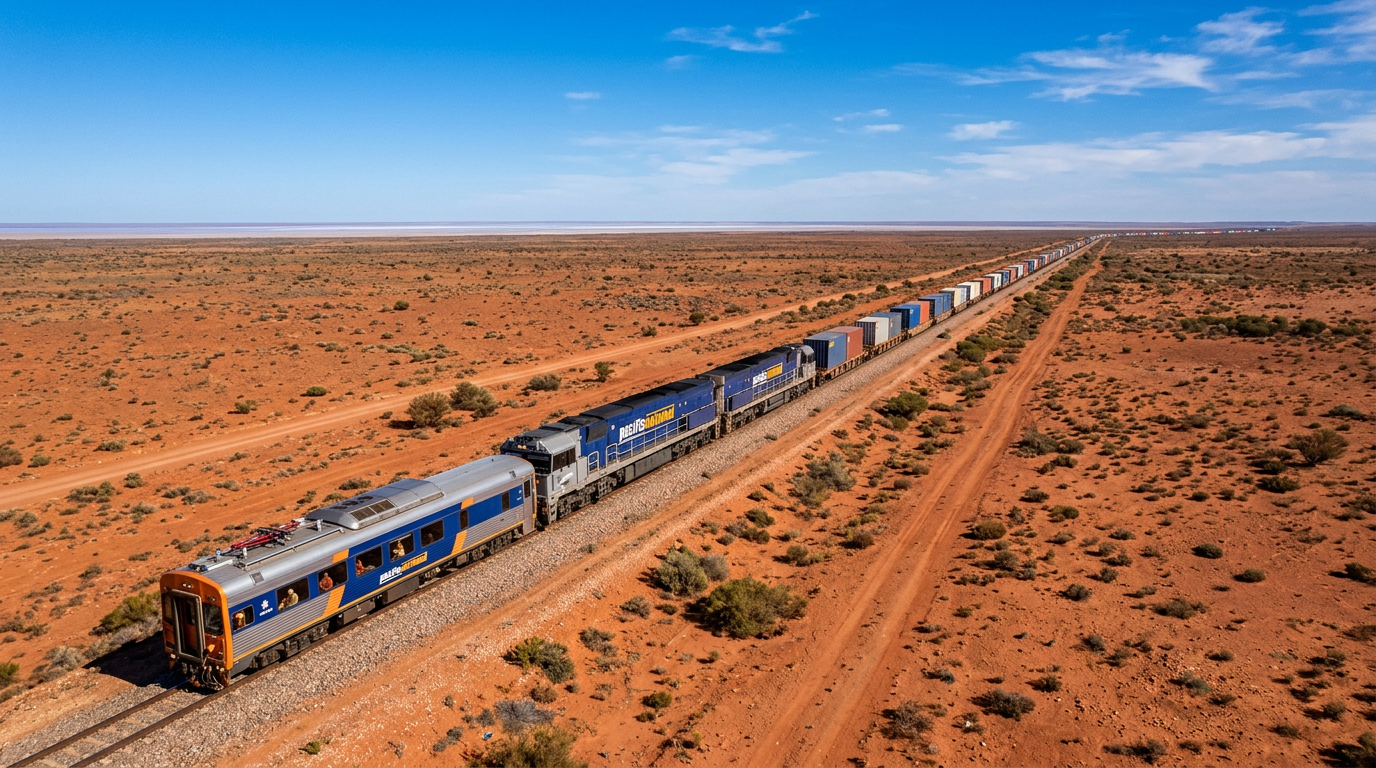

On the Trans-Australian line, between Port Augusta and Kalgoorlie, freight trains travel hundreds of kilometres through the Nullarbor Desert. To prevent crews from falling asleep at the wheel, railway companies have converted passenger carriages into mobile dormitories. In the US, the system is completely different – and the reason is a combination of geography, legislation, and economics.
(Staff: Australia &Amp;United States / Transport & Logistics)
Australia and the United States have something in common: both are vast countries with enormous distances between cities. However, when it comes to rail freight transport, the two countries have made radically different choices. In Australia, freight trains crossing the Nullarbor Desert are equipped with actual sleeping quarters for crews – special wagons called “crew cars”. In America, such a solution does not exist. And the explanation is a fascinating combination of geography, legislation, and economic history.
What are Australian crew cars?
A crew car (or “relay van”) is a passenger carriage converted into living space for freight train crews. They are mainly used on long-distance lines in Australia, where trains travel hundreds of kilometres through desolate areas, with no towns or facilities for the crew.
The interior of a crew car typically includes:
- Individual sleeping compartments for 2-4 crew members
- A kitchen and a lounge area
- Toilet and shower
- Washing machine and dryer
- Own power generation and air conditioning
Why does Australia need them?
Australia has a rail network that runs through extremely remote areas, where there are no cities or motels. The Trans-Australian line, connecting Port Augusta to Kalgoorlie, crosses the Nullarbor Desert over a distance of more than 1,200 kilometres. In these conditions, changing crews at a hotel is not possible.
The Australian solution is simple and efficient: crews are taken on board the crew car and travel with the train. When the active crew reaches the legal limit of working hours, the train stops, the crews change, and the tired team rests in the sleeping carriage. This way, the train doesn’t have to wait hours for a replacement crew, and the efficiency of transport increases significantly.
What happened in America?
In the United States, freight trains once had an equivalent of the crew car: the caboose. This wagon, at the rear of the train, provided shelter for the crew and included sleeping and cooking facilities on long routes. Cabooses were legally required in the US and Canada until the 1980s.
However, with the advent of modern technologies (such as electronic systems for monitoring brakes and axles), the need for an observer at the rear of the train disappeared. The laws requiring cabooses were relaxed, and railway companies quickly phased out these wagons to reduce costs and increase efficiency.
Why haven’t cabooses returned?
The main reason is the structure of the American rail network. In the US, most freight routes are relatively short (under 1,000 kilometres) and run through populated areas where crew facilities exist. Additionally, American rail unions have negotiated limits on working hours, and companies have developed a system for changing crews at fixed points along routes.
Another factor is the economic culture: American railway companies are profit- and efficiency-oriented, and eliminating cabooses was seen as a cost-cutting measure. Reintroducing sleeping carriages would mean a significant investment and increased train weight, which would reduce operational efficiency.
Conclusion
The difference between Australia and the United States regarding sleeping quarters for freight train crews is a perfect example of how geography, legislation, and economics shape technological solutions. Australia chose to transport crews along with the cargo to cope with the vast distances and lack of infrastructure. America chose to abolish this practice, relying on its denser network of cities and modern monitoring technologies. Both solutions are correct for different contexts – and their story shows how much local specificity matters in rail transport..




Leave a Reply