
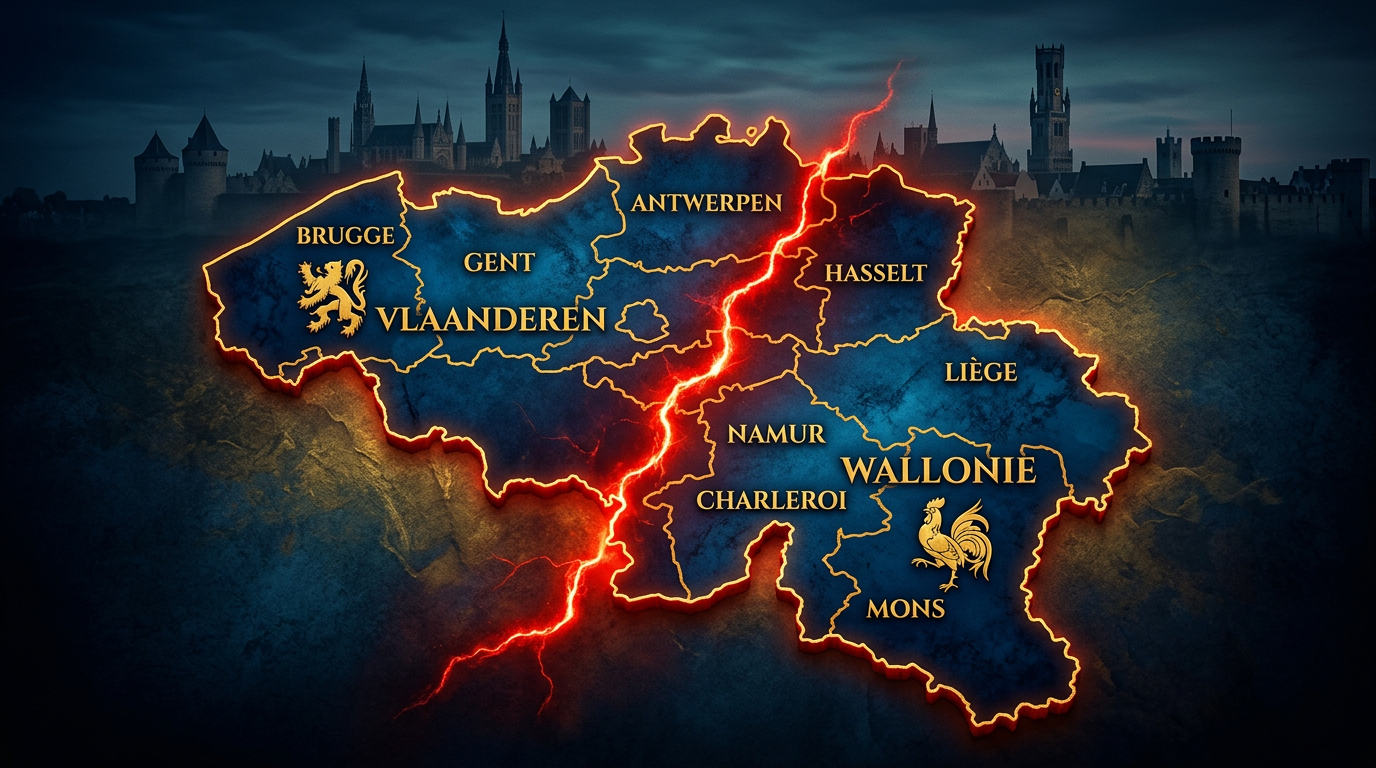

As Belgium faces community tensions, the border between the Germanic and Romance zones is one of the oldest and most stable divisions on the continent. A user on a social network explains why Brussels became French-speaking, why Wallonia speaks French today, and why the current language border is only a shadow of a much more complex reality.
(Staff: Belgium / History & Society)
In the heart of Europe, an invisible line divides the Germanic world from the Romance world. This language border is not an invention of the Belgian state, but a reality that has existed for over 1,500 years. On a social network, Ludo Mineur, a former postman passionate about history, explained in a detailed response how this border has survived empires and shaped the identity of Belgium today.
A border 1,500 years old
Mineur emphasises that the current language border is not an artificial creation. It naturally separates the Germanic zone (Dutch, German) from the Romance zone (French, Walloon). The same border can be found in Luxembourg, in eastern France, in Switzerland, and in the Alps, where it separates German from Italian. “This border has shown considerable robustness over time,” he writes. The only notable exception is on the North Sea coast, where Dutch has lost about 100 kilometres to French.
In Brabant, however, the border has been in roughly the same position for at least 1,500 years, with small fluctuations that have sometimes favoured Dutch and sometimes French.
Why did Brussels become French-speaking?
According to Mineur, Brussels is the only place in Belgium where one can truly speak of “verfransing” (Frenchification) at the expense of Dutch. The main cause was the Industrial Revolution, which created a wealthy bourgeoisie that mirrored the old nobility. Since French had been the language of diplomacy for centuries, and diplomacy was a matter of the nobility, the bourgeoisie adopted French to distance itself from the common man. In Brussels, the language border was more social than geographical: the common man continued to speak the Brabantian dialect, while the bourgeoisie chose French.
Mineur stresses that the role of Dutch in Brussels should not be underestimated. The language has survived, albeit in a more discreet form. Also, Brussels was never Walloon-speaking – unlike Wallonia.
How did Wallonia become French-speaking?
This is an essential part of the answer. Mineur explains that today, in Wallonia, French is spoken instead of Walloon and Picard. This process is not directly related to the Industrial Revolution, but mainly to the strict enforcement of compulsory education after the First World War. Because schools taught in French, Walloon children learned this language en masse, especially in the interwar period. In just two to three generations, the Walloons lost their native languages, replacing them with French. Today, Walloon and Picard are dying – with the exception of a few folkloric initiatives.
Mineur emphasises that Wallonia has never been Dutch-speaking. In cities such as Liège and Namur, Walloon was spoken, and in Mons and Tournai, Picard. This Frenchification of Wallonia is even more recent than that of Brussels.
A permeable border
One often overlooked aspect is that the language border has never been impermeable. In the past, Flemish traders spoke Walloon to do business in Wallonia, and vice versa. Bilingualism was a practical reality in border areas. Mineur gives the example of the painter Rogier Van der Weyden, who was born under the name Roger de la Pasture and simply translated his name into Dutch.
What do the comments say?
The discussion generated numerous reactions. Some users provided examples of towns with dual names (e.g., Jodoigne/Geldenaken, Wavre/Waver, Heylissem/Hélécine), showing that the border is still visible in toponymy. Others raised the issue of migration: Walloons who move to Flanders often remain monolingual, while Flemings who move to Wallonia become bilingual and then integrate.
Conclusion
The Belgian language border is not a political creation, but a deeply rooted historical and cultural reality. It separates two worlds that have coexisted for centuries, but which have been shaped by different forces. The Frenchification of Brussels was a social phenomenon, while the Frenchification of Wallonia was a result of education. Understanding this history is essential to understanding the complexity of Belgium today.


Leave a Reply