
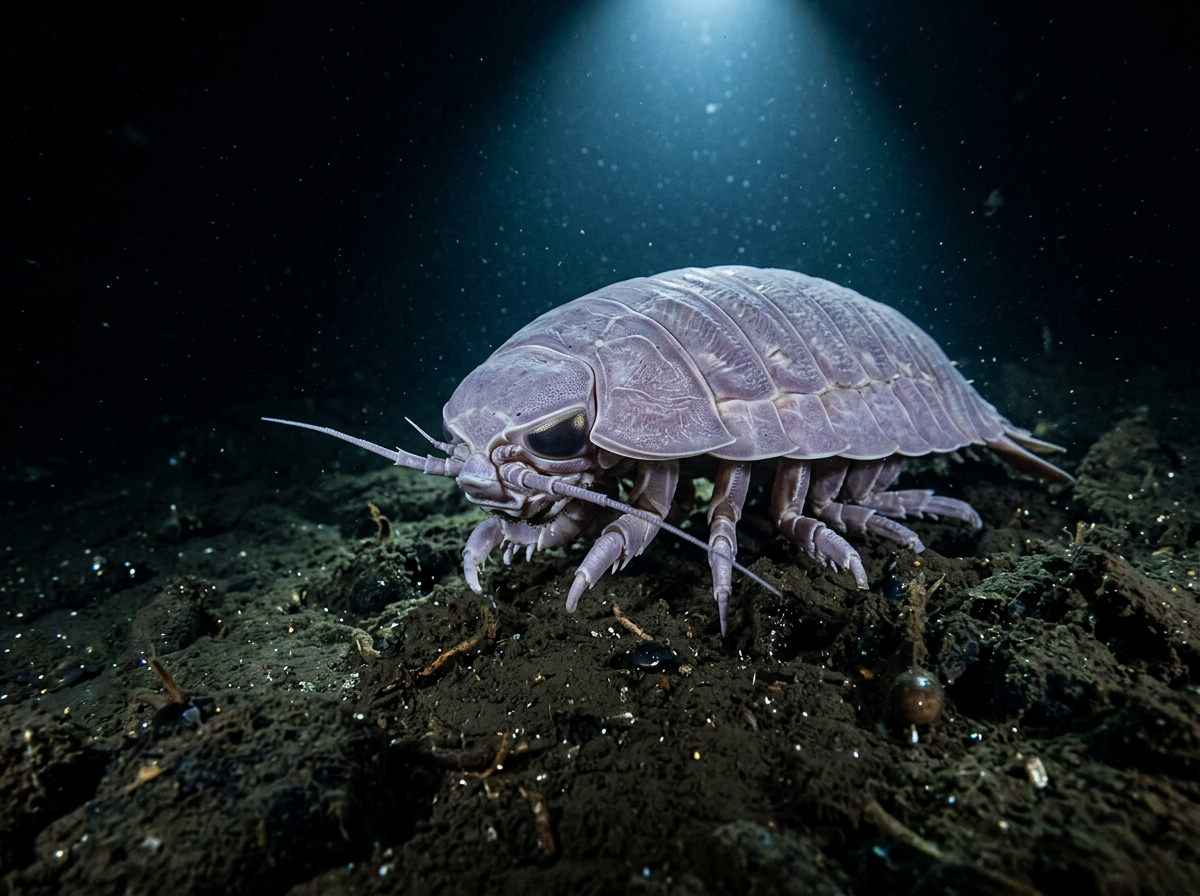

On a social network, a post about a strange deep-sea creature sparked thousands of reactions. It’s about Bathynomus giganteus, a giant crustacean, a relative of the woodlouse, that lives in the absolute darkness of the ocean. It can grow up to 50 centimetres, has 14 legs, and can go without food for more than five years.
(Staff: Global / Science & Nature)
A creature that looks like it’s from a sci-fi movie
Images of a strange animal, filmed in the ocean depths, generated a wave of comments on a social network. The creature, which resembles a giant woodlouse, was identified by users as Bathynomus giganteus, also known as the giant isopod [0†L4-L6]. It is a crustacean that lives at depths of over 2,000 metres, where sunlight never penetrates [1†L9-L10].
What does the giant isopod look like?
The giant isopod is a perfect example of abyssal gigantism – the phenomenon where deep-sea animals grow much larger than their relatives in shallower waters [4†L44-L45][7†L9-L10]. While the garden woodlouse measures a few centimetres, this creature can reach between 19 and 37 centimetres, with some individuals reaching 50 centimetres [1†L18-L20][2†L7][5†L44].
Its body is covered by a hard, calcareous exoskeleton, brown or pale purple in colour, formed from overlapping segments [7†L17-L20][9†L6-L7]. It has 14 legs (seven pairs) [5†L16-L17][7†L24], two compound eyes with over 4,000 facets each, allowing it to detect movement in the dark [1†L38-L39][7†L21-L22], and two pairs of antennae – one long pair to feel the substrate, and one short pair to detect chemical ‘tastes’ in the water [5†L39-L41][7†L27-L28].
Where does it live?
The giant isopod lives on the ocean floor, in the Atlantic, Pacific and Indian Oceans [4†L18-L21][0†L5-L6]. It prefers muddy or clay bottoms, at depths between 170 and 2,140 metres, where pressure is extreme and temperatures are very low [1†L28-L29][7†L14-L15].
What does it eat?
In the deep sea, food is scarce. The giant isopod is primarily a scavenger [4†L17-L18][8†L34]. It feeds on the carcasses of dead animals that fall from the surface – fish, crabs, squid, and occasionally even whale carcasses [5†L27-L28][7†L35][8†L36-L37]. In the absence of food, it can survive up to five years without eating [7†L37-L38][9†L11]. When it finds a rich food source, it gorges itself until it can barely move [7†L40-L41].
Furthermore, it has been discovered that the giant isopod also ingests microplastics, which reach even the deepest parts of the ocean [8†L39-L44].
A history of over 160 million years
The species was first scientifically described in 1879 by the French zoologist Alphonse Milne-Edwards [4†L29-L34][9†L12]. It is estimated to have existed for about 160 million years, and is considered a ‘living fossil‘ [9†L12].
Conclusion
The giant isopod is one of the most fascinating creatures of the deep. Although its appearance may seem frightening, it plays an essential role in the marine ecosystem, cleaning the ocean floor of dead animal remains. Its discovery, nearly 150 years ago, proved that life can exist even in the most extreme conditions, in the absolute darkness of the abyss.




Leave a Reply