
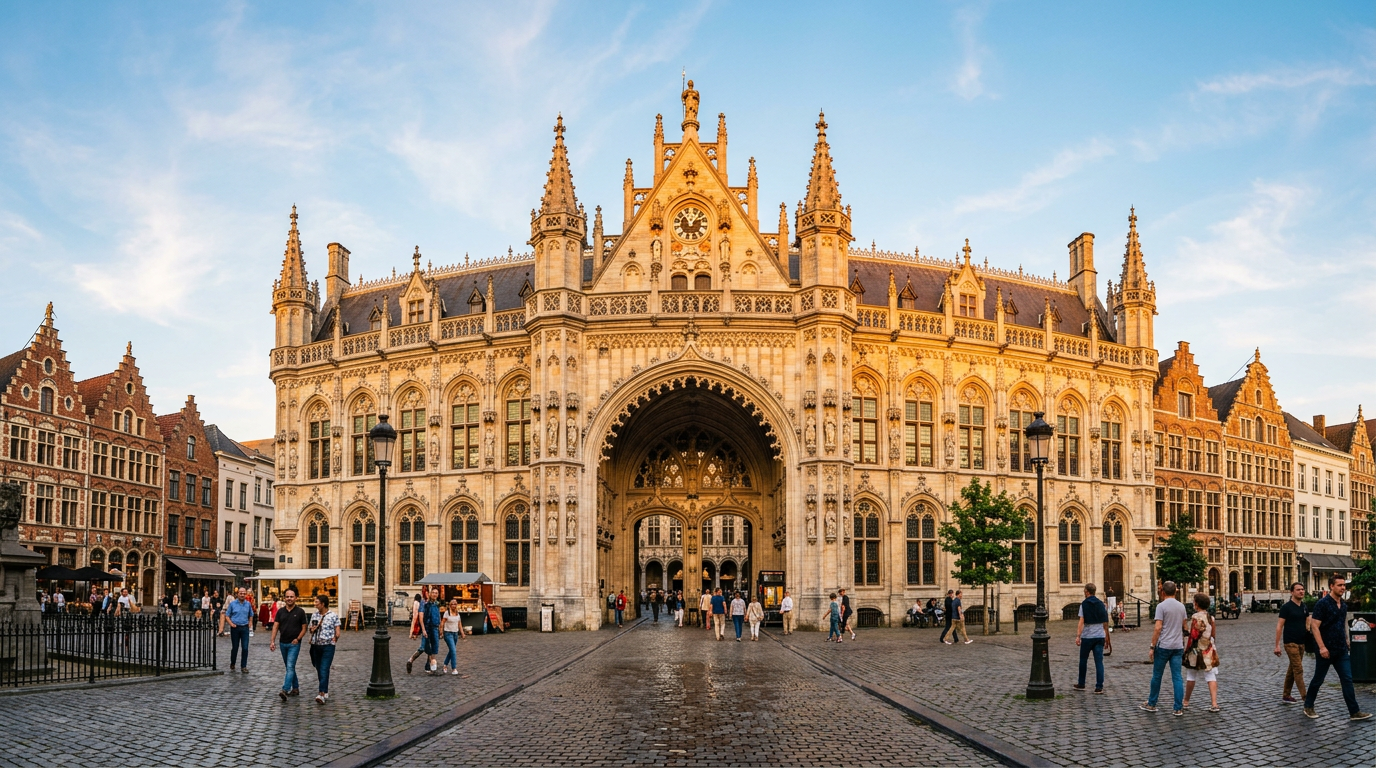

In 1531, in the heart of Antwerp, a building was erected that would change the financial history of the world. The “Handelsbeurs” – the Trade Exchange – was the world’s first purpose-built financial trading venue. Merchants from all over the world met here to trade debt securities and government bonds. It was “the mother of all stock exchanges”.
(Staff: Belgium / History & Finance)
A building built for global trade
In 1531, Antwerp was one of the most important commercial centres in Europe. The city had over 100,000 inhabitants, including about 10,000 foreign merchants, mostly Spanish and Portuguese . The unprecedented economic development required adequate infrastructure for financial transactions. Thus, in 1531, the Handelsbeurs (Trade Exchange) building was inaugurated, designed by architect Domien de Waghemakere in the Flamboyant Gothic style of the Low Countries . It was the first building in the world built specifically to serve as a commodity exchange . The inscription on the building’s pediment was symbolic: “Open to merchants of all nations and all languages” (in usum negotiatorum cujuscumque nationis ac linguae) .
What was traded at the Antwerp Exchange?
Although it is considered the first stock exchange in the world, stocks as we know them today were not traded in Antwerp. The concept of shares had not yet been invented . Instead, government bonds and debt securities – promises of payment issued by states or private individuals – were traded here . Merchants and bankers met in the inner courtyard, which was originally open to the sky, to conclude commercial and financial transactions.
“The mother of all stock exchanges”
The Antwerp Exchange became a model for other European cities. In 1565, the English banker Thomas Gresham, a frequent visitor to the Antwerp Exchange, returned to London and built the Royal Exchange, inspired by the design of the Antwerp building . For this reason, the Antwerp Exchange is often called “the mother of all stock exchanges” .
Decline and reconstruction
The golden age of the Antwerp Exchange lasted about a century. After the fall of Antwerp to Spanish troops in 1585, the commercial and financial centre of Europe moved to Amsterdam, and the exchange fell into decline . The building burned down in 1583 and again in 1858 . It was rebuilt in 1872 by architect Jos Schudde, who largely recreated the original Gothic style, and served as a stock exchange again until 1997, when it merged with the Brussels Stock Exchange (now Euronext) .
The building today
After a period of neglect, the building was restored between 2016 and 2019, and today it is a multipurpose space, known as the Antwerp Trade Fair . The inner courtyard is now covered, and the arcades house small shops, including a florist and a Belgian chocolatier .
Conclusion
The Antwerp Exchange, opened in 1531, was a pioneer of modern finance. It demonstrated for the first time that financial transactions could be organised in a dedicated space, open to merchants of all nationalities. Although it no longer functions as an exchange today, its legacy remains alive, and its building is a monument to Europe’s economic history.


Leave a Reply