
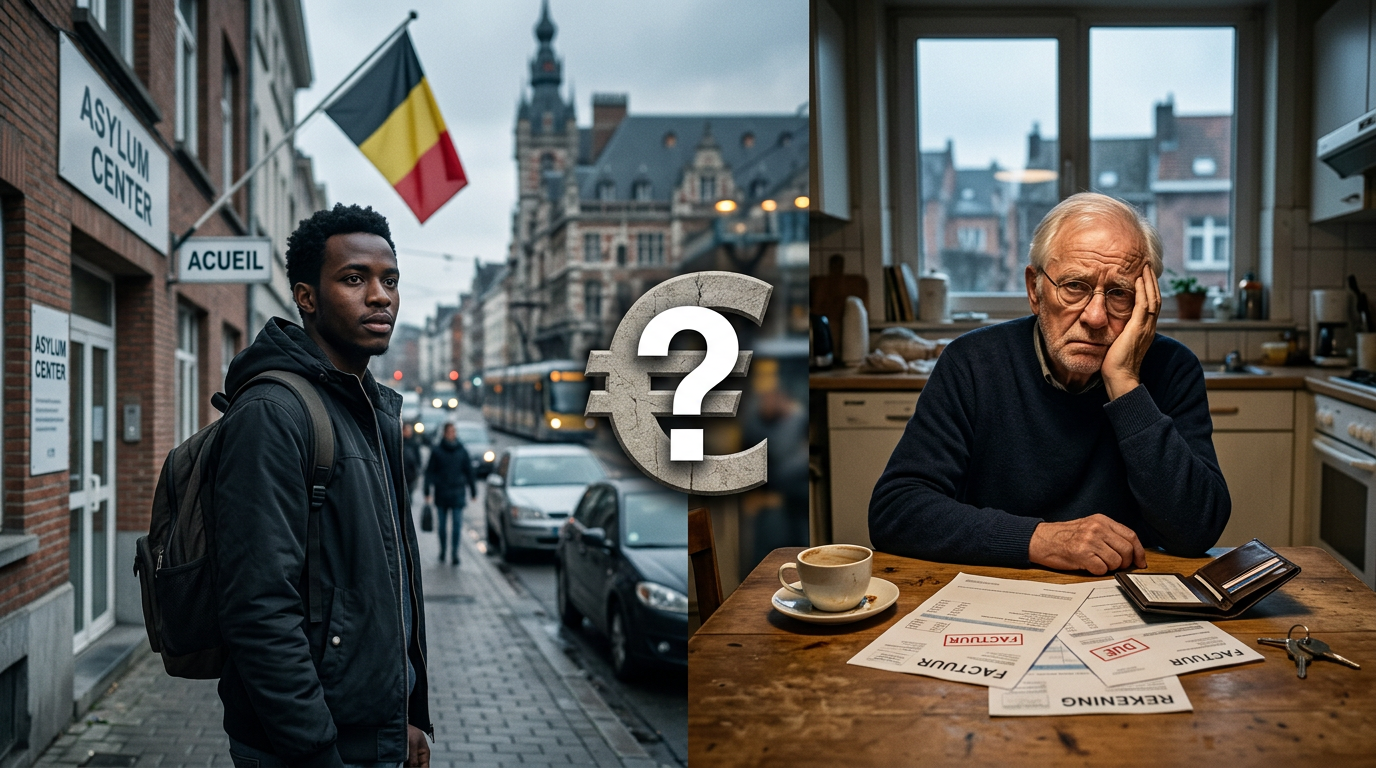

A picture shared online claims that a recognized refugee receives almost €1,400 net in social assistance, while a pensioner with 40 years of work and contributions receives only €1,600 net. The €200 difference is presented as proof that the Belgian system punishes those who have worked all their lives. The reality is more nuanced: the figures are not directly comparable, and the terms are used incorrectly.
(Staff: Belgium / Society & Social Protection)
A viral post on social media, accompanied by the logo “Wakker België”, has sparked a wave of reactions in Belgium. The image compares two situations: a young man presented as an “officially recognized asylum seeker, single”, who allegedly receives “almost €1,400 net as a living allowance”, and a pensioner who “worked for 40 years, always contributed and paid taxes” and allegedly receives a “€1,600 net pension”. The difference of only €200 is described as proof that “the pension system in Belgium is a big farce”.
The post also contains a harsh comment directed at the political class, speaking of “ministers with expensive cars, drivers, generous salaries and double pensions”, while “their own population is being pushed into poverty”. Such messages are increasingly circulating and exploit real frustrations. But what is true and what is misleading in this comparison?
The confusion between “asylum seeker” and “recognized refugee”
The first problem is terminological. In Belgium, an asylum seeker whose application is still being processed does not receive €1,400 net per month. They are accommodated in a reception centre and receive material assistance (accommodation, food, medical care) and much lower pocket money. Only after being officially recognized as a refugee can they apply for certain social benefits, including the social integration income (leefloon) from the OCMW.
So the image does not compare an “asylum seeker” with a pensioner, but rather a recognized refugee without income, who receives social assistance, with a pensioner. That is an important distinction.

Leefloon is social assistance granted by the OCMW to people who do not have sufficient resources and cannot work. It is not an automatic entitlement and is not a fixed amount for everyone. The amount depends on the family situation (single, with a partner, with children) and is indexed. For a single person, the amount is close to €1,400 net, but this is temporary social assistance, not a salary or pension. The beneficiary must meet certain conditions, including being willing to work and cooperating with the OCMW.
What is a pension and how much is paid?
In Belgium, a pension is a social insurance system, not social assistance. It is calculated on the basis of a person’s professional career, wages and contributions paid over the years. There is no single amount of €1,600 net for all pensioners. Some receive more, others less. There is a guaranteed minimum pension for people with a full career, which for a single person is close to €1,600 net, but many pensioners have lower pensions because of incomplete careers, poorly paid jobs or periods of unemployment.
The comparison is flawed from the outset
A direct comparison of the two amounts is misleading for several reasons:
- One is social assistance for people without income, while the other is a pension based on contributions.
- Leefloon is temporary and conditional; a pension is an entitlement earned through work.
- The amount shown in the image for the refugee assumes that the person has no income and meets all the conditions; it is not a general rule.
- The amount shown for the pensioner assumes a full career and a certain level of earnings; it is not universal either.
- Taxes, contributions paid throughout life or other benefits (bonuses, discounts, heating support, etc.) are not taken into account.
Criticism of the political class
The original post is not limited to comparing a refugee and a pensioner. It also harshly criticizes the political class: ministers with expensive cars, drivers, high salaries and advantageous pensions. There is a grain of truth here. Salaries of Belgian ministers and members of parliament are high compared with average income, and their privileges (cars, drivers, secretariats, special pensions) are frequently disputed. The debate about the transparency and fairness of these benefits is legitimate.
However, generalizing that all politicians are “parasites” and that the entire system is a “farce” does not help to understand the real problems. The Belgian pension system faces serious challenges: an ageing population, financial sustainability and inequalities between careers. These require reforms, not just indignation.
Why do such messages resonate?
Such posts go viral because they touch a sensitive nerve: many Belgians feel they have worked all their lives and do not have enough resources in old age, while others who have not contributed may receive similar benefits. It is a real frustration, fuelled by the cost of living, the housing crisis and distrust in institutions. But solutions cannot come from simplistic comparisons.
Conclusion
The viral image uses real figures but places them in different contexts to create the impression of a glaring injustice. A recognized refugee without income may receive social assistance of around €1,400, while a pensioner with a full career may receive a minimum pension of approximately €1,600 net. But the two amounts are not comparable: one is temporary social assistance, the other is a social-insurance entitlement. Criticism of politicians’ privileges is legitimate, but turning it into an attack on all refugees or the entire social protection system is a dangerous simplification. A serious debate about pensions and social benefits must start from facts, not memes.



Leave a Reply