
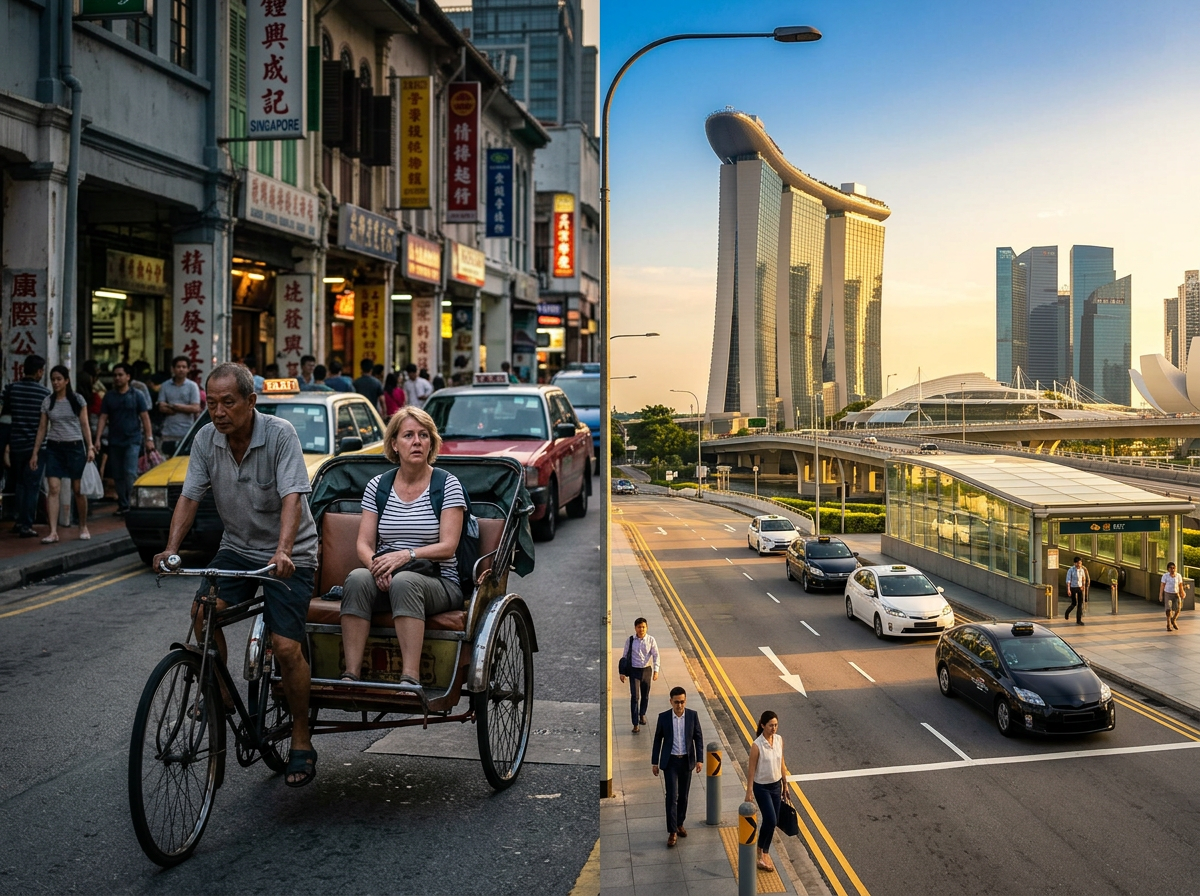

On a social network, a user sparked a heated debate after recounting an unpleasant experience in Singapore, considered one of the safest cities in the world. His story attracted hundreds of comments, from those who confirm that tourists are seen as “money bags” to those who firmly defend the safety and civilisation of the city-state.
(Staff: Singapore / Tourism & Society)
An incident that sparked controversy
Michael Johannes Nieuwesteeg, a Dutch sailor now retired, shared on a social network a story that marked him in his youth, during an internship in Singapore. Arriving in the city with little money, he chose a rickshaw to get to the entertainment centre. At the destination, the driver demanded the equivalent of 120 guilders for a ride of only 10 minutes. Nieuwesteeg offered him half the amount, and within moments he was surrounded by six rickshaw drivers who physically threatened him. He paid the demanded amount and walked back.
Safety is guaranteed, but at a cost
Despite the incident, the user did not question the city’s overall safety, but emphasised that it comes at a price. “Singapore is safe, as long as you have enough money,” he wrote. The story attracted dozens of comments, and opinions were divided. Some confirmed that tourists are seen as “money bags” and that similar scams are common. Others defended Singapore, emphasising that it is one of the safest and cleanest cities in the world, and that incidents of this kind are exceptions.
A debate about safety and price
The comments revealed a more complex reality. A user who lived in Singapore for 1.5 years explained that the city’s safety is not about the wallet, but about a strict system of laws and controls. He emphasised that while rent and cars are expensive, local food is still cheap and the city is an excellent gateway to the rest of Asia. Another commenter pointed out that prices for tourist services are much higher than for locals, but that this is true in many Asian countries.
A city that has changed
Several users noted that Nieuwesteeg’s experience had taken place many years ago. Singapore has changed significantly, and public transport, including taxis, is now efficient and transparent. One user compared prices: a 35-minute ride in Singapore costs around 21 euros, while the same distance in the Netherlands costs 35 euros.
What does the law say?
Singapore is known for its strict laws and harsh penalties, including for minor offences. This rigidity is often cited as the main reason for its safety. From the ban on chewing gum to severe penalties for drug use, the state exercises strict control over the behaviour of citizens and visitors.
Conclusion
Nieuwesteeg’s story is a reminder that safety is not a universal concept and that its perception can vary depending on personal experiences. Singapore remains, by all accounts, one of the safest cities in the world, but travellers are advised to be vigilant and to inform themselves before arriving. Whether it is a city of strict rules or a destination for those with deep pockets, Singapore continues to be a fascinating enigma for those who visit it.




Leave a Reply