
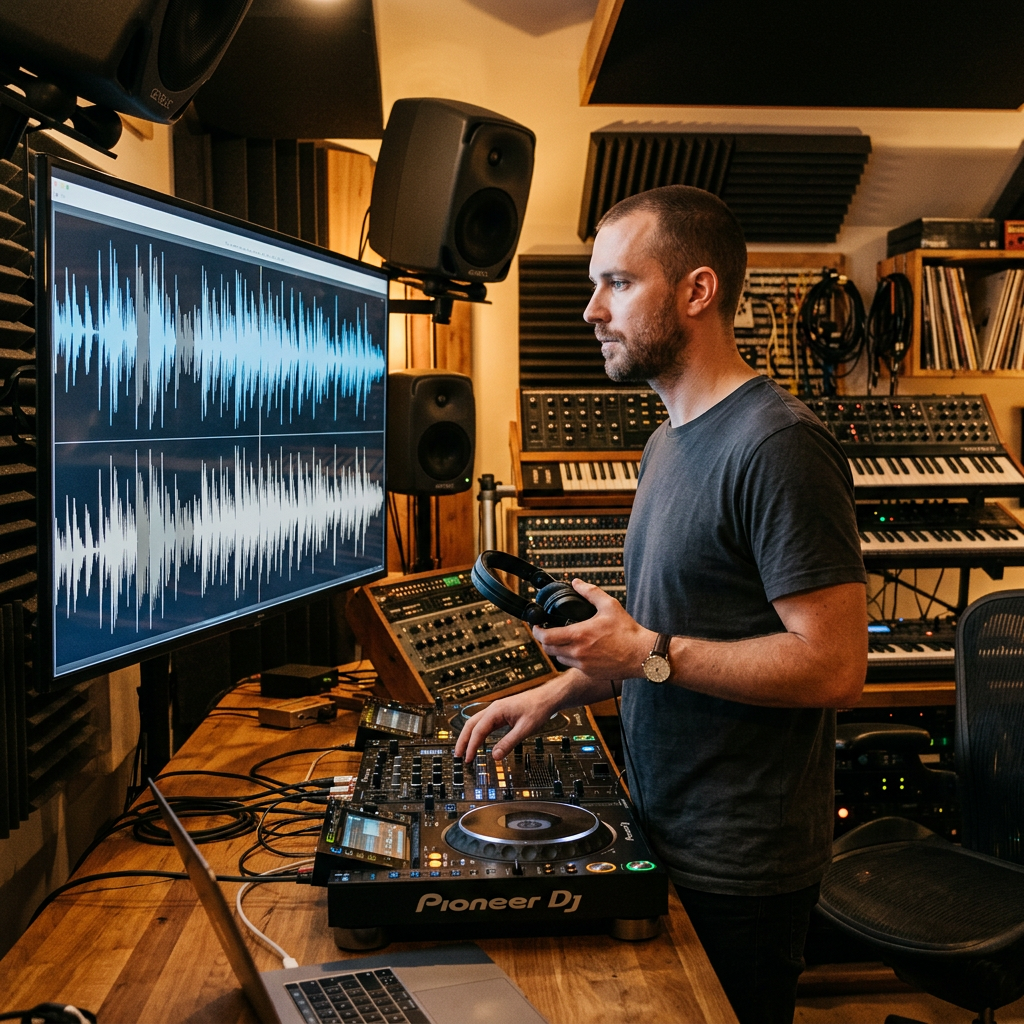

The Australian Recording Industry Association (ARIA) has ruled that recordings must be “substantially human made” to be eligible for the charts. The decision comes after a Madonna cover, which reached No. 1 on the dance chart and garnered over 48 million streams on Spotify, sparked controversy after it was revealed that the vocals and drums were generated by artificial intelligence.
(Staff: Australia / Music & Technology)
Australia has banned fully AI-generated songs from its official music charts, following a controversial cover of Madonna’s “Like a Prayer” that sparked a wave of reactions. The Australian Recording Industry Association (ARIA), which manages Australia’s official charts, has ruled that recordings must be “substantially human made” to be eligible. The new rules will be applied for the first time in the chart published on Friday. In contrast, tracks that use “generative AI in a supporting role” and are “substantially human made” will be allowed. “Wholly AI-generated tracks” or songs that use AI “to generate the entirety or the primary portion of the creative elements” will be ineligible.
A controversial Madonna cover at the centre of attention
The decision comes at a sensitive time for DJ and producer Josh Fawaz, whose version of “Like a Prayer” became the most-played song on Australian radio in July and is currently No. 1 on the ARIA Australian Dance Singles chart. Fawaz’s cover, which spent 16 weeks on the Top 20 Australian Singles chart and is currently at No. 4, has become the subject of dispute as it continued to climb the charts.
Music producer Mitch Thomas, who performs as Needs No Sleep, claimed on social media that Fawaz’s music was “generated entirely with AI” and said it sounded like music produced using the generative AI platform Suno. Fawaz dismissed the criticism, telling him to “stop having a little sook” and said he used AI “as a tool”.
Spotify, updated credits and massive streams
The track’s Spotify credits were subsequently updated to acknowledge that AI had been used for its vocals and drums and has since amassed more than 48 million streams on the platform. While ARIA has not yet confirmed that Fawaz’s track will be removed, a spokesperson from the organisation told the Australian Broadcasting Corporation that music featuring AI-generated lead vocals or key instrumental parts would likely be excluded under the new rules.
ARIA CEO’s reaction
Annabelle Herd, ARIA CEO, said the rules would allow artists to use AI while keeping human creativity at the heart of the charts. “Artists already use AI tools in their work, the Charts can and should evolve to keep room for that, but music generated wholesale by services built on artists’ recordings is a different matter,” Herd said. She added that a chart rewarding “unlicensed AI output” would undermine the purpose of the charts, which are intended to measure the music Australians are actually consuming.
A growing international trend
The change follows a similar move in Sweden, where an AI-generated song was kept off the country’s official chart earlier this year despite becoming a streaming hit. The track “Jag vet, du är inte min”, released under the name Jacub, had attracted about five million Spotify streams and topped Spotify’s Swedish rankings before IFPI Sweden ruled that it was primarily AI-generated and barred it from the official Sverigetopplistan chart. The International Federation of the Phonographic Industry (IFPI) has since been pushing to stop AI-generated songs from competing with human-made recordings on official charts. In July, the IFPI announced new eligibility rules requiring chart entries to be substantially human-made, with more than 20 official chart programmes adopting the principles. ARIA said its new rules were drawn up in line with the IFPI framework.
Conclusion
Australia’s decision marks an important moment in the relationship between artificial intelligence and the music industry. As AI technology becomes increasingly advanced and accessible, the question of authenticity and origin of music becomes more relevant. It remains to be seen whether other countries will follow Australia and Sweden’s example and how the rules will evolve to balance technological innovation with the protection of human creativity.



Leave a Reply