
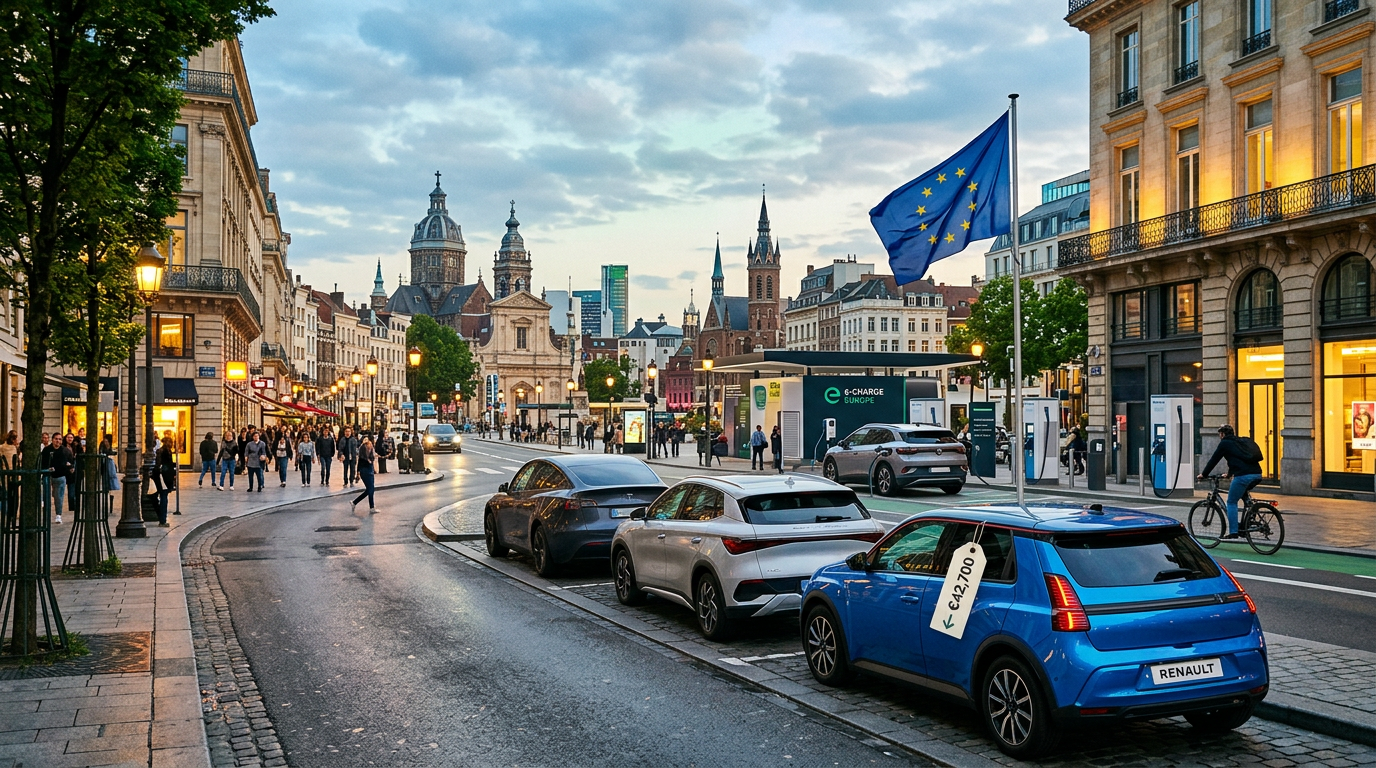

For the first time since 2020, the average price of an electric car has fallen in Europe. Chinese brands are increasingly dominating the market, while governments in more and more countries are offering generous subsidies. But how quickly will we reach price parity with petrol cars, and what does this mean for the pocket of the European consumer?
(Staff: Europe / Automobiles & Economics)
Good news for anyone considering buying an electric car in Europe: prices have finally started to fall. According to an analysis published by Transport & Environment (T&E), the average price of a battery electric vehicle (BEV) in the European Union fell in 2025 for the first time since 2020. More precisely, the average price fell by around €1,800 (-4%), reaching €42,700.
This decline is not accidental. It is the direct result of pressure from European CO₂-emission reduction targets for 2025–2027, which require carmakers to sell more electric vehicles to avoid substantial fines. To meet these targets, manufacturers have had to launch smaller and more affordable models, particularly in the B segment (compact cars), where prices fell by 13% in 2025.
Chinese brands: a decisive factor
Another important driver of falling prices is increasingly fierce competition from Chinese carmakers. According to a T&E analysis, in the first quarter of 2026, Chinese-made electric cars were on average 21% cheaper than those from European manufacturers, even after the European Union imposed tariffs of up to 35.3% to limit their expansion.
This competitiveness is also reflected in market shares. Chinese brands such as BYD, MG, XPENG and Geely reached a record 14.2% share of the Western European electric-car market in the first five months of 2026, compared with around 9% the previous year. In the second quarter of 2026, their combined share rose to 10.7% of total new-car sales across 18 Western European countries.
Chinese manufacturers manage to keep prices low thanks to almost complete control over the battery supply chain, from battery cells to power electronics, allowing them to reduce costs significantly. In addition, many are moving production to Europe – BYD in Hungary, Leapmotor through Stellantis and Geely in Spain – to bypass import tariffs.
Government subsidies: easier purchasing conditions
In addition to lower list prices, European governments continue to support electric-car purchases through direct subsidies and tax incentives. According to data cited in the article, all EU member states except Latvia offer at least one type of incentive for electric cars – either a purchase subsidy, tax exemption or support for charging infrastructure.
Here are some concrete examples of support available in 2026:
- Italy: up to €11,000, depending on income and scrapping an old car .
- Cyprus: up to €19,000 under certain conditions, the highest level of support in Europe .
- Germany: up to €6,000, depending on income, retroactive for cars registered from January 2026.
- France: up to €5,700, plus a social-leasing programme for 100,000 electric vehicles for low-income people .
- Spain: up to €4,500 for cars manufactured in the EU .
These subsidies are intended to reduce the initial cost of an electric car, which remains the main obstacle to widespread adoption. The total cost of ownership (TCO), including energy, maintenance and taxes, is already lower for electric cars in many situations, but the purchase price remains the major psychological barrier.
When will we reach price parity?
According to T&E, price parity between electric and combustion-engine cars could be reached across all segments by 2030, provided the European Union maintains its ambitious CO₂ targets for 2030. In the upper segments (D and E – large and luxury cars), parity is already a reality, while T&E expects segments A, B and C (small and compact cars) to follow by the end of the decade.
However, there is a significant risk: weakening the European CO₂ targets for 2030. If they are diluted, T&E warns that the average price of an electric car could be €2,300 higher in 2030 than under the current scenario, while the BEV market share could fall from 57% to just 32%. This would delay price parity and slow the transition to electromobility.
Conclusion
The future of electric cars in Europe is promising, but it is not without challenges. Prices are falling, subsidies are significant, and Chinese competition is forcing European manufacturers to become more efficient. By 2030, an electric car could cost the same as a petrol-powered one, while operating costs are already significantly lower. For European consumers, purchasing conditions are becoming increasingly favourable. It remains to be seen whether policymakers will maintain the ambitious course that has driven this change or yield to industry pressure and delay the transition.




Leave a Reply