
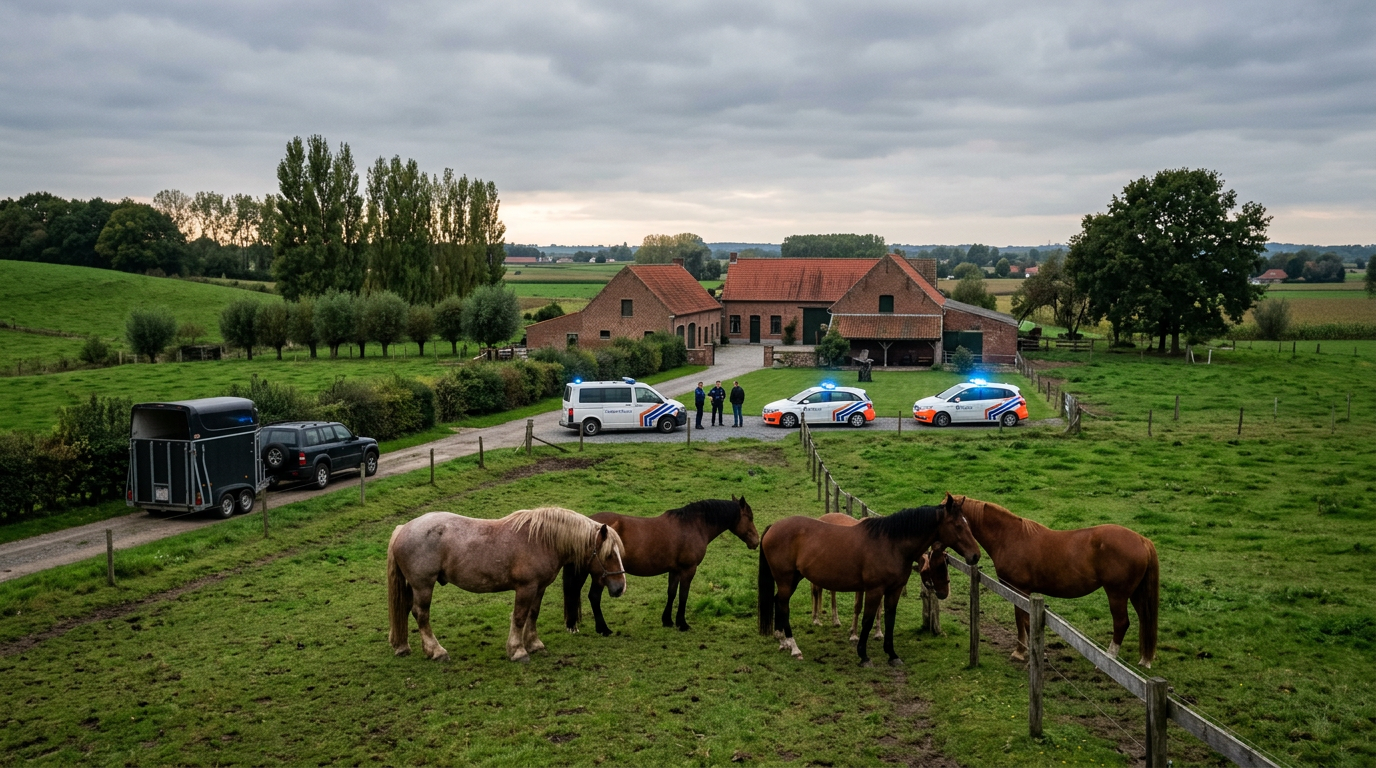

The investigation, coordinated by the Federal Judicial Police of East Flanders and the Federal Agency for the Safety of the Food Chain, targets an international network that brought horses from Ireland to be slaughtered, although some had received prohibited medication. Twenty-four searches were carried out in Belgium, the Netherlands, France and Ireland. Three suspects were detained in Belgium, two of whom remain in custody.
(Staff: Belgium / Justice & Food Safety)
The Dendermonde Council Chamber decided on Tuesday, September 15, 2026, to extend the pre-trial detention of the second suspect arrested in the investigation into horses unsuitable for human consumption. He is a 54-year-old man from Kruisem, who will remain in prison for another month. The decision follows last Friday’s ruling by the same court to extend the detention of the first suspect, a 45-year-old man from Sint-Gillis-Waas.
An international network of “recycled” horses
The investigation was launched by the Federal Judicial Police of East Flanders in cooperation with the Federal Agency for the Safety of the Food Chain (FAVV). Investigators uncovered a system in which horses that were not intended for human consumption — for example, sport horses that had received various medications — were fraudulently declared fit for slaughter. According to investigators, a significant number of these horses came from Ireland and were exported to Europe, eventually ending up in slaughterhouses.
An East Flanders horse dealer is considered by police and the East Flanders Public Prosecutor’s Office to be a central figure in the network, allegedly working with other suspects in the Netherlands, France and Ireland.
Searches in four countries
Last week, investigators carried out 24 searches in Belgium, the Netherlands, France and Ireland. In Belgium, three people were detained for questioning. The investigating judge ordered the pre-trial detention of two of them — the 45-year-old man from Sint-Gillis-Waas and the 54-year-old man from Kruisem. The third suspect, a 36-year-old woman from Sint-Gillis-Waas, was released under judicial supervision.
On Friday, the two men appeared before the Dendermonde Council Chamber. The court extended the first man’s detention by one month but postponed its decision on the second. On Tuesday, the Council Chamber decided that the second man would also remain in pre-trial detention for another month.
What happens next?
The investigation is continuing under the supervision of the investigating judge. Belgian authorities are working with their counterparts in the Netherlands, France and Ireland to dismantle the entire network and determine the scale of the alleged fraud. Investigators are also examining how existing systems may have been exploited to allow animals that did not meet the legal requirements to enter the food chain.
Conclusion
The case involving horses unsuitable for human consumption highlights vulnerabilities in the traceability system for animals intended for slaughter. Although the investigation is still at an early stage, the continued detention of the two suspects underlines the authorities’ determination to combat this type of fraud, which can pose a serious food-safety risk to European consumers.




Leave a Reply